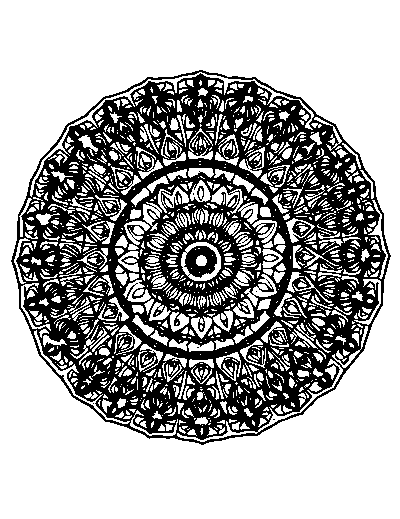
Unicorn Mandala
- Età rakkomandata
- 9-12
- Diffikultà
- 4 / 5
- Dettall
- medium
- Żoni li għandhom jiġu kkuluriti
- 318
- Kopertura tal-linka
- 7.4%
- Piż tal-linja
- Fine
- L-eqreb distakk
- 0.4 mm
- Liċenzja
- CC0 qasam pubbliku: b'xejn għall-klassijiet u l-użu kummerċjali
This is a free printable Unicorn Mandala coloring page. It has 318 separate areas to color, fine outlines, and covers about 7.4% of the sheet in ink. It prints on one page at 300 DPI on both US Letter and A4.
Printing this page
Standard 20 lb / 80 gsm copy paper handles this page. If you plan to use markers rather than pencils, 24 lb / 90 gsm will stop the color showing through.
Print at 100% scale rather than "fit to page". Both downloads already leave a 0.25 in (6 mm) margin, which is inside the unprintable edge of every common home and office printer, so nothing gets clipped. The file contains no color at all, so the black-only setting prints it faster and cheaper.
If it does not print right
If the lines print gray rather than black, check that the printer is not in draft mode and that you have not accidentally selected a color profile: a pure black-and-white file sent through a color profile can come out as a muddy composite black built from all four inks.
What's on the page
There are 318 enclosed areas on this page: the separate pockets the outlines divide the drawing into. That is what decides whether a page feels quick or absorbing, far more than the subject does.
The narrowest channel between two lines measures about 0.37 mm at full print size. We measure this on every page because it is what decides whether a marker will bleed across an outline.
The composition is centered, which is worth knowing before you print: it determines how much white space sits around the edge of the drawing.
What to color it with
For this page we would use colored pencils or 0.5 mm fine liners only. Broad markers and crayons will bleed straight across the thin gaps and lose the detail.
Who this page suits
We put this page at roughly the 9-12 age range, based on the line weight and how many separate areas it has, not on the subject. Plenty of adults color pages meant for children and the other way round; the band is a starting point.
At this age coloring works best framed as a quiet reset rather than as a reward. It holds attention without demanding it, which makes it useful after something cognitively heavy.
What to look for in this drawing
Mandalas reward symmetry in the coloring as well as the drawing. Decide whether you are mirroring colors across the whole design or letting each ring have its own scheme, and commit before you start: switching halfway is what makes a mandala look unfinished.
How to color this page well
Work from the center of interest outwards, and leave the background until last. That way the background color is chosen to support what is already on the page instead of fighting it. If you want depth, press harder at the edges of each shape and lighter towards the middle: it is the fastest way to stop a flat fill looking flat.
Keep your pencil sharp. On fine linework a blunt tip will spread over two or three adjacent areas at once, and once two neighboring shapes have merged there is no undoing it.
What to do with it once it is colored
A finished mandala frames well: it is the one kind of coloring page that looks deliberate on a wall. It also makes good gift wrap, and cut into a circle and mounted on card it becomes a coaster or a hanging decoration.
Printed at full size the artwork sits within a 0.25 in margin, so there is a clean border to cut along if you are mounting or framing it.
How to color the Unicorn Mandala page
- Print it at full size. Standard 20 lb / 80 gsm copy paper handles this page. If you plan to use markers rather than pencils, 24 lb / 90 gsm will stop the color showing through. Set your printer to 100% or "Actual size" (never "Fit to page") so the page prints at true 300 DPI and the right size for US Letter or A4.
- Choose your coloring tools. For this page, reach for colored pencils or 0.5 mm fine liners only. Broad markers and crayons will bleed straight across the thin gaps and lose the detail.
- Plan your colors. Pick two or three colors that sit well together and repeat them ring by ring. A mandala reads best when the pattern of color is as symmetrical as the drawing.
- Color in the right order. Treat it as several sittings. Pick one region of the page per session and finish it completely: chasing a single color across hundreds of tiny areas is what makes an intricate page frustrating.
- Add depth last. Save shading and outlining for the end. Press a little harder at the edges of each shape and ease off toward the middle: that single trick makes a flat colored page look finished.
- Save or display your work. When you are done, color it online with the "Color this page" button, or photograph your printed sheet: you can keep a copy in your gallery or turn it into a print.