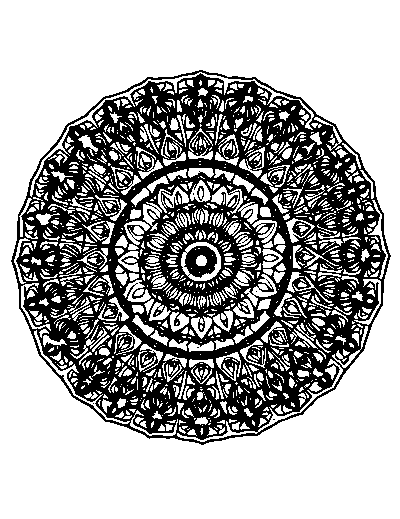
Simple Mandala
- প্ৰস্তাবিত বয়স
- 9-12
- কঠিনতা
- 4 / 5
- বিৱৰণ
- high
- ৰঙিন কৰিবলে অঞ্চলসমূহ
- 775
- কাগজ আৱৰণ
- 19.8%
- শাৰী ওজন
- Medium
- সৰ্বাধিক সংকীৰ্ণ ফাঁকা স্থান
- 0.4 mm
- অনুমতি
- CC0 পাবলিক ডমেইন: ক্লাছৰুমত আৰু বাণিজ্যিক ব্যৱহাৰৰ বাবে বিনামূলীয়া
This is a free printable Simple Mandala coloring page. It has 775 separate areas to color, medium outlines, and covers about 19.8% of the sheet in ink. It prints on one page at 300 DPI on both US Letter and A4.
Printing this page
Use 24 lb / 90 gsm paper or heavier. There is a lot of ink on this page, and on thin copy paper it can show through the back and buckle slightly as it dries.
Print at 100% scale rather than "fit to page". Both downloads already leave a 0.25 in (6 mm) margin, which is inside the unprintable edge of every common home and office printer, so nothing gets clipped. The file contains no color at all, so the black-only setting prints it faster and cheaper.
If it does not print right
With this much ink on the page, watch for two things: the sheet curling as it dries, and the back of the previous sheet picking up ink in the output tray. Both are fixed by heavier paper or by letting each sheet dry flat before stacking it.
What's on the page
There are 775 enclosed areas on this page: the separate pockets the outlines divide the drawing into. That is what decides whether a page feels quick or absorbing, far more than the subject does.
The narrowest channel between two lines measures about 0.37 mm at full print size. We measure this on every page because it is what decides whether a marker will bleed across an outline.
The composition is centered, which is worth knowing before you print: it determines how much white space sits around the edge of the drawing.
What to color it with
For this page we would use colored pencils or fine-tip markers. A broad marker will cross the narrower gaps before you can stop it.
Who this page suits
We put this page at roughly the 9-12 age range, based on the line weight and how many separate areas it has, not on the subject. Plenty of adults color pages meant for children and the other way round; the band is a starting point.
At this age coloring works best framed as a quiet reset rather than as a reward. It holds attention without demanding it, which makes it useful after something cognitively heavy.
What to look for in this drawing
Mandalas reward symmetry in the coloring as well as the drawing. Decide whether you are mirroring colors across the whole design or letting each ring have its own scheme, and commit before you start: switching halfway is what makes a mandala look unfinished.
How to color this page well
On a page with this many separate areas, the usual mistake is to start coloring immediately and run out of patience halfway. Plan a limited palette first: four to six colors, and decide which one repeats most often. Then work in passes: lay down every area of your first color across the whole page, then the second, and so on. It is faster, it keeps the result coherent, and it means an unfinished page still looks intentional.
Stay just inside the outlines rather than aiming exactly at them. A one-millimetre margin of white next to the line reads as crisp; crossing the line reads as messy.
What to do with it once it is colored
A finished mandala frames well: it is the one kind of coloring page that looks deliberate on a wall. It also makes good gift wrap, and cut into a circle and mounted on card it becomes a coaster or a hanging decoration.
Printed at full size the artwork sits within a 0.25 in margin, so there is a clean border to cut along if you are mounting or framing it.
How to color the Simple Mandala page
- Print it at full size. Use 24 lb / 90 gsm paper or heavier. There is a lot of ink on this page, and on thin copy paper it can show through the back and buckle slightly as it dries. Set your printer to 100% or "Actual size" (never "Fit to page") so the page prints at true 300 DPI and the right size for US Letter or A4.
- Choose your coloring tools. For this page, reach for colored pencils or fine-tip markers. A broad marker will cross the narrower gaps before you can stop it.
- Plan your colors. Pick two or three colors that sit well together and repeat them ring by ring. A mandala reads best when the pattern of color is as symmetrical as the drawing.
- Color in the right order. Treat it as several sittings. Pick one region of the page per session and finish it completely: chasing a single color across hundreds of tiny areas is what makes an intricate page frustrating.
- Add depth last. Save shading and outlining for the end. Press a little harder at the edges of each shape and ease off toward the middle: that single trick makes a flat colored page look finished.
- Save or display your work. When you are done, color it online with the "Color this page" button, or photograph your printed sheet: you can keep a copy in your gallery or turn it into a print.